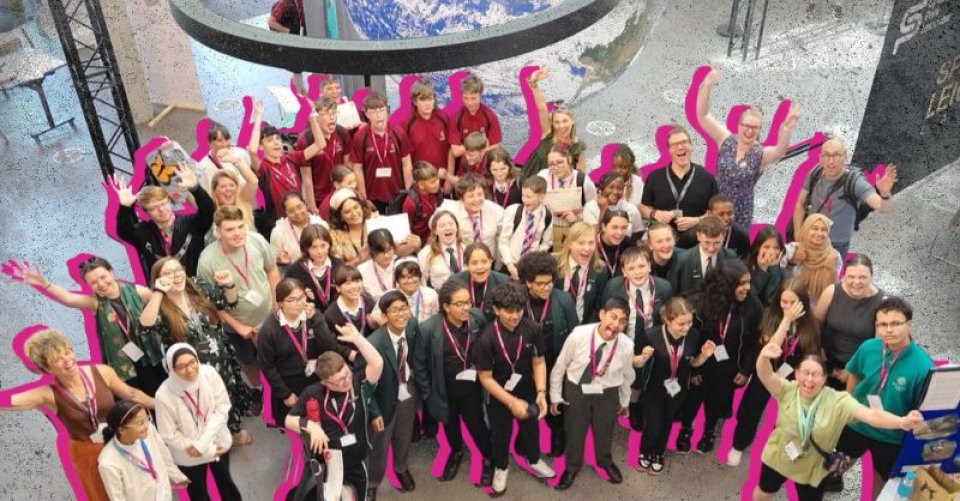
Young people often incorrectly assume that others don’t care as much about protecting the environment as they do. This feeds a cycle of dwindling hope and engagement, alarming in an age group that will require resilience to deal with the crisis.
I really love the ethos behind [this project], and strongly feel we need to have more conversations about values.
Teacher at participating school

Take Action
Get in touch to talk about how your organisation can support our work creating change in education.
The change we want to see
The project builds on recent empirical developments showing that people across ages and from around the world agree on the importance of values, such as protecting the environment, and that making people aware of these ‘shared values’ elicits a sense of connectedness and hope about the future.
This research drives systems change by tackling a key psychological and social barrier to environmental engagement: the misperception of others' values. It achieves this by:
Empowering Young People: Helping them see themselves as part of a broader movement, fostering a stronger belief in the power of collective action.
Breaking Negative Cycles: Disrupting the loop of misperception, hopelessness, and inaction to re-engage individuals in meaningful environmental efforts.
Fostering Resilience: Highlighting shared values and a sense of connectedness, providing a hopeful counter-narrative to despair and inspiring long-term commitment to environmental challenges.
Values perception gap; so, what did we find?
Across more than 1000 young people aged 12-24, we saw that their values are overwhelmingly similar. For example, 95% of young people say that values like protecting the environment, helping others, and world peace are highly important to them.
But importantly, young people often miss these similarities and assume their peers care about very different things. For example, 77% of young people believe they personally value caring for others and protecting the environment more highly than their peers do. We discussed these results with our Youth Advisory Board, who helped us put together the video below summarising the findings.
We’re proud to be working with the University of Bath to develop an intervention to help young people discover their shared values. In a world that can feel increasingly fragmented and polarised, it’s never been so important to nurture social connectedness and, subsequently, collective action.
Claire Arnott, Head of Good Life Schools, Global Action Plan
You can read more about the project on the Global Action Plan Education site
Read more
Global Action Plan is collaborating with the University of Bath on this project funded by the UK Research and Innovation (UKRI) Economic and Social Research Council (ESRC).


Related content


_960_crop_960.jpg)


_1200_630.jpg)