The UK has finite clean power and water resources and they are being disproportionately gobbled up by AI data centres. Is an AI data centre planned near you?
More than one hundred data centres are currently being planned or built without consideration of the societal and environmental harms they will cause.
Data centres are warehouses full of computers – servers and processors – that are proliferating in large part due to the explosion in AI tools like ChatGPT and Midjourney. These require massive amounts of compute power – a ChatGPT query uses 10x as much energy as a google search, for instance.
The computers in data centres are running all the time, using an enormous amount of electricity and running very hot, requiring cooling with a massive quantity of water. There is far too little scrutiny of these environmental impacts, something Global Action Plan is campaigning to change.
Data centres have vast resources demands, impacting local water availability and having national power consumption implications - severely effecting our ability to move to the UK aims of clean power by 2030.
We want government to implement a framework that sets out how many data centres are needed, where, what for, the acceptable limit of environmental harm they cause, and how they must mitigate that harm. We want the industry to report transparently on its power and water usage so all of us – governments and communities – can assess their environmental impacts and weigh it against any benefits they bring. In lieu of those two things, we want a pause or ‘moratorium’ on the construction of new AI data centres.

Take Action
Call on the Government to implement a moratorium on AI data centres until climate and community concerns can be addressed
Proposed data centres
This map of proposed data centres in the UK is a work in progress. Let us know if there is a data centre planned near you and we will add it to the map. Similarly, if you or a campaign group is organising to challenge data centre plans near you, get in touch.
Find out more about
Data Centres
Help us take the government to court.
We need your help to raise the essential costs for this and make sure we can see this challenge through. Let's stand up for our environment, our resources, and our communities.
Big tech is hoovering up the UK’s precious water and clean energy supplies to fuel its AI boom, imposing enormous data centres on communities up and down the country. We urgently need public scrutiny of what is going on in these vast warehouses, and rules of the road for those intent on building them.
Oliver Hayes, Head of Policy & Campaigns
Want to know more about the problems with data centres?
What is a data centre?
Data centres are essentially warehouses for computers – containing large numbers of servers, storage devices and networking equipment, accompanied by an equally large amount of cooling equipment. The number of these facilities is growing exponentially due to the explosion of AI tools like ChatGPT.
Data centres store a lot of data – the ‘cloud’ is just a name for all the servers in data centres on which files are stored. They also process a lot of data, particularly when training AI models or in response to AI queries from users.
Because they contain so many computers that are running constantly, they require massive amounts of energy to power. They also require backup (usually diesel) generators to make sure their power is uninterrupted, and cooling systems to stop the technology from overheating.
What are data centres used for?
As the economy becomes increasingly digital, businesses and organisations are storing, analysing and processing more and more data.
Data centres are used for all manner of purposes – from storing photos and emails, facilitating video calls and streaming, to training and operating generative AI models like ChatGPT and other chatbots.
Global Action Plan asked the Government to give us more information on what the UK’s data centres are being used for, and they told us they are not keeping track. This means it’s very difficult estimate how much data centre capacity is being used for useful things that benefit society – storage needs, or activity supporting medical research, for instance – and how much is for wasteful, harmful or potentially illegal activity such as sycophantic and inaccurate chatbots, surveillance advertising, deepfakes or porn.
However, we do know that Artificial Intelligence (AI) requires ever growing data storage and processing capacity. The data centre requirements of chatbots and generative AI video creation tools vastly outweigh those of non-AI digital activity.
Do data centres benefit the economy or create jobs?
The Government and tech companies claim that data centres will support digital innovation, and that the wider adoption of AI will drive growth in the economy. They also claim data centres and AI will create jobs and therefore growth.
In reality, data centres are heavily capital and resource intensive but typically create little in the way of local jobs or economic growth: for example, a new hyperscale datacentre to be constructed and operated by BlackStone in Blyth, north-east England, will support only 400 full time on-site jobs. That equates to £25m per job. As Opportunity Green point out:
“Whilst this, like other investments, is private money, there are direct costs to the wider public in introducing very substantial new demands to increasingly congested public infrastructure like the energy grid. Black Stone’s owners are exclusively US-based: any profits generated by the site will, as with other data centres around the world, flow offshore and a long way from local communities”
As well as minimal job creation, AI puts existing jobs at risk due to automation. Think tanks like the IPPR have warned that increased use of AI could threaten up to 8 million jobs. Trade unions believe AI will benefit workers most when they are able to work with businesses to shape how it is adopted and highlight the negative impacts that algorithmic management has on job quality and the health and safety of workers.
- Up to 8 million UK jobs at risk from AI unless government acts, finds IPPR | IPPR, March 2024
- 10 Principles for Ethical AI | The Future World of Work
- Question for Department for Science, Innovation and Technology | Parliament, January 2025
- Data centres: how soaring demand threatens to overwhelm energy systems and climate goals | Opportunity Green, May 2025
What impact do data centres have on the environment?
While AI is often marketed as a potential technological solution to global sustainability challenges by big tech, politicians and the media, experts argue that its infrastructure – particularly data centres – is causing very real environmental harms today.
A single new data centre will have energy requirements equivalent to an entire medium sized town, and there are more than 100 planned in the UK.
The National Energy System Operator has said national power use by data centres could reach 71 TWh every year by 2050. That’s equivalent to the energy use of millions of households, and more than the entire commercial sector today.
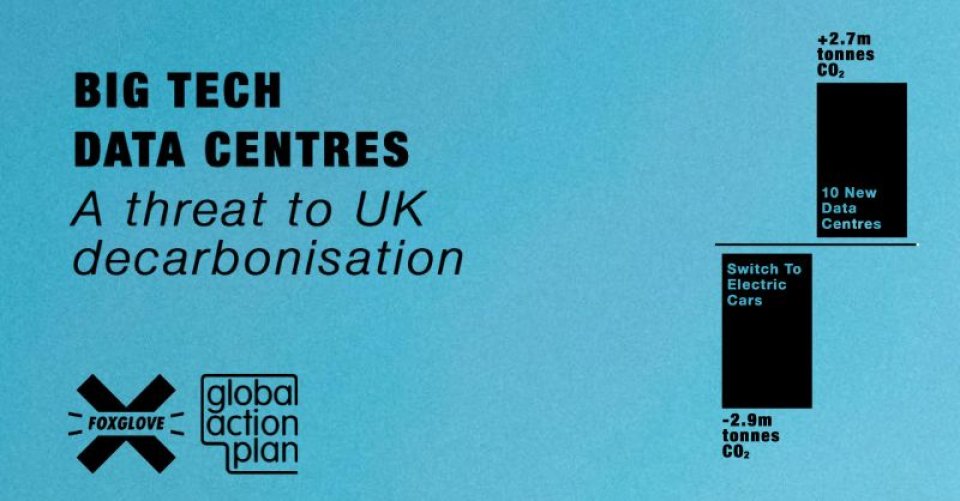
The growing power requirements of data centres risk jeopardising the UK’s climate action and efforts to decarbonise the grid, as extra electricity demand for data centres outstrips the construction of new renewables. Emissions from just ten planned UK data centres will wipe out this year’s CO₂ savings from the switch to EVs. Developers are seeking direct gas grid connections, a move supported by the NVIDIA chief, and considered by the Government’s AI Energy Council. Large tech companies' reported CO₂ emissions have increased in line with the AI boom and many are scaling back or abandoning climate commitments.
Despite many claims that many data centres are powered by “100% renewables”, the experience from other countries is that additional power demand from data centres is being mostly met by fossil fuels. The power requirements of AI are particularly concerning – a single ChatGPT query can consume up to ten times the energy of a standard web search.
Data centres also require vast quantities of water. By 2027, AI-related data centres alone are expected to withdraw between 4.2 and 6.6 billion cubic metres of water globally – that's roughly equivalent to half the UK’s annual water use. As droughts become more common, data centres will compete with local people for water supplies, with a single hyperscale facility consuming a similar amount of water to a small city.
Hyperscale data centres consume huge amounts of finite and increasingly scarce resources, including power and drinking water, as well as generating large amounts of new carbon emissions. The manufacture of the millions of chips required for data centres also creates massive demands for minerals and other natural resources in the supply chain.
- Energy Secretary Ed Miliband sets out his priorities for the department | Department for Energy Security and Net Zero, July 2024
- The Environmental Impacts of AI -- Primer | HuggingFace, September 2024
- Future Energy Scenarios: Pathways to Net Zero | NESO, July 2025
- Amazon data centres to consume ‘as much electricity to power Burnley’ | The Telegraph, June 2025
- Data centres to be expanded across UK as concerns mount | BBC, August 2025
- The growing energy footprint of artificial intelligence | Alex de Vries, October 2023
- Ten UK data centres could cancel EV emissions gain | The Observer, October 2025
- Data centres look to tap UK gas pipelines to meet power demand | Financial Times, August 2025
- Nvidia says Britain will have to burn gas to power technology revolution | The Times, September 2025
- UK’s AI ambitions clash with its climate goals | Politico, August 2025
- Why Big Corporations Are Quietly Abandoning Their Climate Commitments? | Forbes, August 2024
Where are data centres currently/planned for?
Big Tech is rolling out data centres at an increasingly rapid pace, and the UK Government is welcoming them. Though no-one seems to have exact figures, there are reported to be more data centres in the UK than anywhere else in Western Europe, with an estimated 477 data centres in the UK currently. This figure is expected to increase by almost 100 as the growth of AI demands more processing power. However, the data centres planned or in construction are orders of magnitude bigger than those currently in existence – some of those planned will require as much electricity as is produced by a nuclear power station.
Data centres tend to ‘cluster’. Many currently in existence are in the M4 corridor between London and Slough. Of the 100 planned new hyperscale data centres, 28 are earmarked for London, putting even more strains on the capital’s power and water resources. Thames Water has said it is already supplying 140 data centres.
The strain on local electricity grids caused by data centres in and around London has already resulted in housing projects being paused.
You can find out if there is a data centre in your area by inputting your town or postcode into our interactive map here.
As part of its AI Opportunities Plan, the Government is pushing for areas of the UK to be designated ‘AI growth zones’, where the industry will be given priority access to power and water.
Who makes decisions about data centres?
Big Tech is investing billions in data centre expansion in the UK. However, there is little transparency about which companies are behind individual data centre developments.
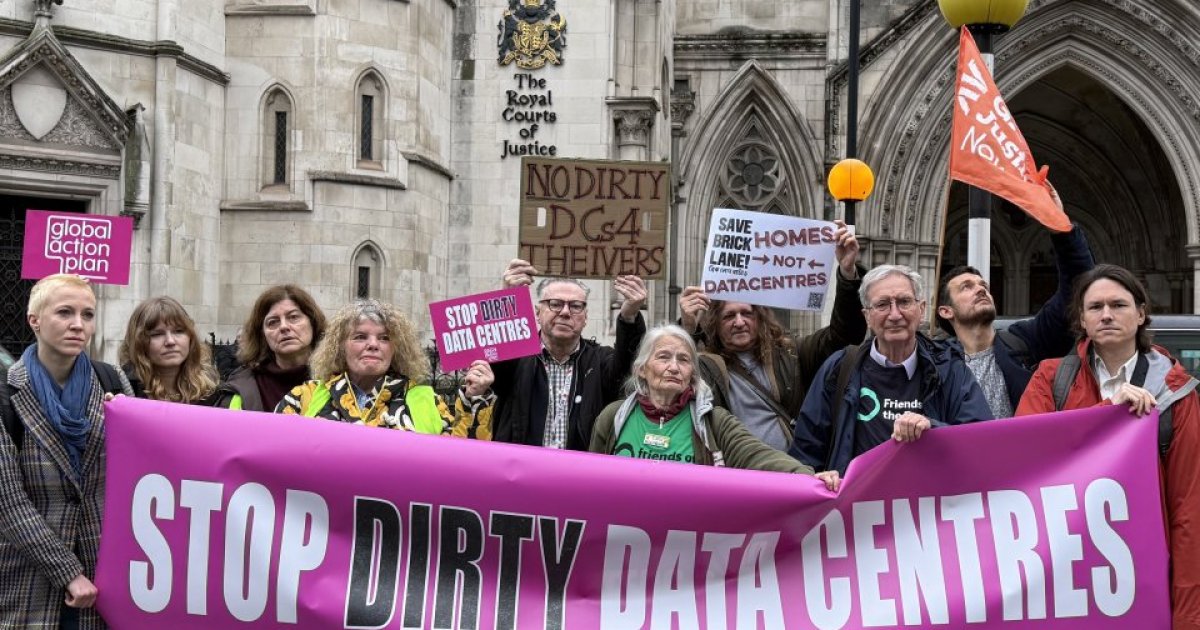
All new data centres require planning permission, which is currently granted by Local Authorities. However, the UK Government has overruled several local rejections of data centre applications. Global Action Plan is currently challenging one of these cases in court, on the grounds that the Government’s decision does not take into account the data centre’s environmental impacts.
In a bid to bypass local planning, the Government is classing data centres as “Nationally Significant Infrastructure Projects” in an attempt to centralise and streamline decisions. These projects almost always get approved.
What can I do if a data centre is planned in my area?
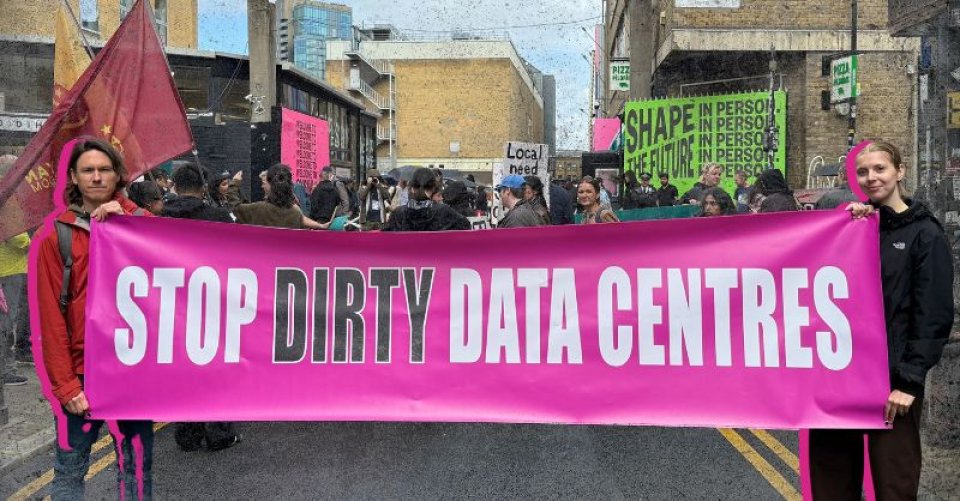
Wherever data centres are planned, communities have been coming together to speak out and shape decisions about their local area. By working together, sharing information and strengthening each other’s voices, we can ensure our communities’ views are heard and respected by decision makers. In some cases, communities have even managed to stop plans to build inappropriate data centres in their neighbourhoods.
Global Action Plan wants to help anyone living close to a proposed data centre to have their voice heard and connect with other concerned citizens. Get in touch and let us know your view about data centres in your community.
With thanks
to the individual supporters who make this work possible
Related content




22nd January 26
22/01/26